





The China+1 tailwind, the rupee’s quiet challenge, and why gold denominated in rupees is the most compelling savings story in Asia
Something significant happened to the global economy between 2020 and 2025, and it happened largely without fanfare, obscured by the noise of the pandemic, the Ukraine war, and the tariff disputes that dominated financial headlines. The world quietly, systematically, began to decouple from China.
It was not a single decision by any government or corporation. It was millions of individual procurement decisions, supply chain risk assessments, insurance underwriting reviews, and geopolitical calculations that all pointed in the same direction: the extraordinary concentration of global manufacturing in a single country — a concentration that had defined the world economy since China’s accession to the WTO in 2001 — was a risk that needed to be reduced.
The beneficiaries of this decoupling are still being determined. Vietnam, Indonesia, Mexico, and a handful of other manufacturing economies have captured significant flows of redirected investment. But the country most systematically positioned to benefit — in terms of scale, demographics, English-language capability, legal infrastructure, and explicit government policy — is India.
This is the context in which every Indian saver should be thinking about gold.

The rupee’s quiet challenge
India’s economic growth story is real. The country’s GDP has grown at rates that the developed world can barely imagine. Its digital infrastructure — from UPI to Aadhaar to the Jan Dhan banking initiative — is genuinely world-class and has created a financial inclusion story with few parallels in history.
But growth and currency stability are not the same thing. The Indian rupee has depreciated against the US dollar by approximately 3 to 4 percent per year on average over the past two decades. This is not a crisis. It is not even unusual by emerging market standards. But it is a persistent, structural reality that has real implications for Indian savers.
If you hold your savings in rupees — in a fixed deposit, a savings account, or a rupee-denominated bond — the purchasing power of those savings in international terms declines by roughly 3 to 4 percent per year, before accounting for domestic inflation, before accounting for tax on interest income. The real return on a standard Indian savings account, properly calculated in terms of global purchasing power, is frequently negative.
Gold, priced in international markets in US dollars, provides a natural hedge against rupee depreciation. When the rupee weakens against the dollar — as it has, consistently, over decades — the rupee price of gold rises to compensate. An Indian gold saver benefits not only from any rise in the international gold price but also from the depreciation of the currency they are saving in. This is not speculation — it is arithmetic.
Over the past twenty years, gold in rupee terms has delivered an average annual return of approximately 13 to 14 percent. Against a backdrop of 6 to 7 percent domestic inflation and 3 to 4 percent annual rupee depreciation, this is a real positive return that very few other asset classes available to ordinary Indian investors have matched with comparable consistency and lower risk.
The China+1 inflation wave
The rewiring of global supply chains away from China is not deflationary. It is inflationary. Chinese manufacturing was the great deflationary force of the global economy for thirty years — its combination of low labour costs, extraordinary scale, and ruthless efficiency suppressed the price of almost every manufactured good that Indians, Americans, and Europeans bought. Undoing that will take decades and will cost more.
For India, this creates a paradox. As a beneficiary of supply chain diversification, India gains investment, jobs, and manufacturing capacity. But as a participant in a more expensive global trade system, India’s consumers face structurally higher prices for a wide range of imported goods, components, and commodities.
This is a recipe for persistent inflation — not the acute, dramatic inflation of a currency crisis, but the slow, grinding inflation of a structural shift in global trade economics. And persistent inflation, as every monetary historian knows, is the condition in which gold performs best over extended periods.
The demographic dividend and the savings imperative
India has the youngest population of any major economy on earth. The median age in India is approximately 28 years — compared to 38 in China, 42 in the United States, 47 in Japan, and 46 in Germany. This demographic reality creates what economists call a savings imperative: a large, young, earning population that needs to accumulate assets for retirement, for family obligations, for emergencies, and for the aspirations — education, homeownership, pilgrimage — that drive human beings to save in the first place.
This generation of Indian savers is different from previous ones in important ways. They are digital-native. They are financially more literate than their parents, partly because of social media and financial content creators, and partly because the post-2020 investment boom brought millions of young Indians into equity markets for the first time. They are aware, at some level, of the risks of keeping too much in cash or low-return savings accounts.
They are also, for the most part, Muslim or not, instinctively drawn to gold. India’s cultural relationship with gold is not specific to any religion or region — it is woven into the fabric of how Indians understand wealth, family obligation, and financial security.

The opportunity: systematic gold savings for 1.4 billion people
The convergence of these forces — the India growth story, the rupee depreciation reality, the inflationary supply chain rewiring, the demographic savings imperative, and the cultural affinity for gold — creates what may be the most compelling savings opportunity of the decade.
For the first time in history, the oldest and most culturally resonant savings instrument available to Indian families — physical gold — is accessible without the traditional friction of making charges, storage risk, purity uncertainty, and illiquidity. Digital gold platforms have solved these problems. The result is an asset class that has delivered double-digit rupee returns for twenty years, carries no counterparty risk, requires no minimum investment, and can be purchased, saved, gifted, and redeemed from a smartphone.
India’s golden decade is not a metaphor. It is a compound interest calculation waiting to happen.

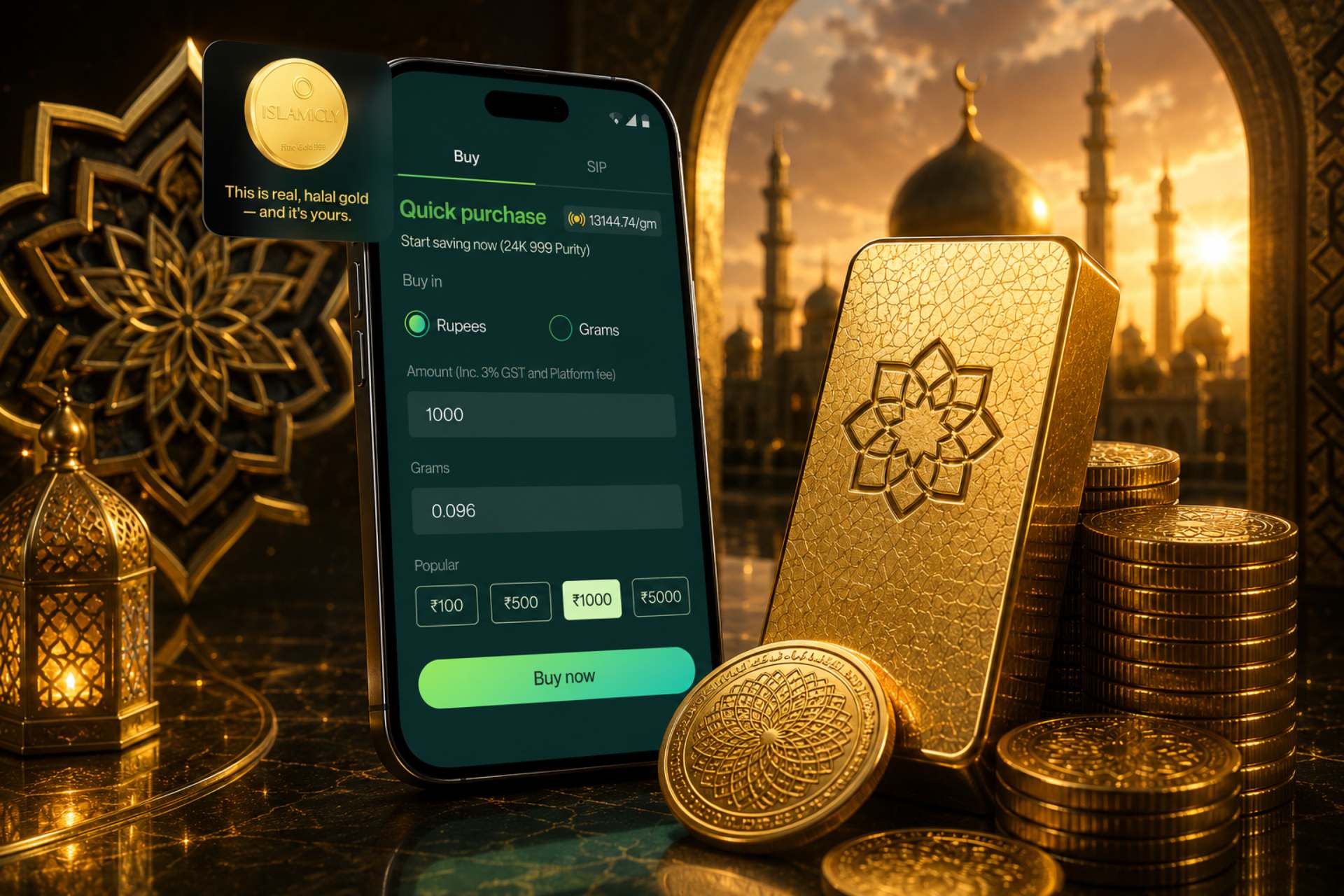
Gold by Islamicly App is built for this moment — systematic gold savings for every Indian, starting from ₹100 a day, in your name, insured and allocated.


No comments yet — be the first to share your thoughts.