





The mathematics of Riba — and what 1,400 years of Islamic wisdom knew that modern economists are only beginning to admit
Consider a simple thought experiment. Your grandfather, in 1975, had two options. He could deposit ₹10,000 in a savings account at the prevailing interest rate. Or he could buy gold.
The savings account, compounded faithfully at whatever rates banks offered across five decades, would have grown to a respectable nominal sum. The gold, however, would have grown from roughly ₹500 per gram in 1975 to over ₹15,000 per gram today an appreciation of approximately 30 times in real terms, consistently outpacing inflation across every decade in between.
This is not a cherry-picked comparison. It is a pattern that has repeated, with remarkable consistency, across every major economy, every currency crisis, and every inflationary period of the last century. Gold preserves wealth. Interest-bearing cash deposits, in real terms, frequently do not.
The irony is exquisite. The financial instrument that is supposed to reward savers the interest-bearing deposit account has, in most periods and most economies, delivered returns that barely keep pace with inflation after tax. Meanwhile, the asset that pays no interest, generates no yield, and simply sits in a vault has delivered some of the most reliable long-term wealth preservation available to ordinary investors.
The prohibition that makes economic sense
Islamic law’s prohibition of Riba — typically translated as interest, though the concept is broader — is one of the most discussed and least understood principles in Islamic finance. To many observers raised in a Western financial tradition, it seems counterintuitive. If I lend you money, why shouldn’t I charge for the time value of that money? Isn’t interest simply the price of credit?
The Islamic answer to this question is nuanced and, viewed through the lens of modern behavioural economics and financial history, remarkably prescient.
The classical Islamic jurists argued that Riba creates a fundamentally unjust transfer of risk. When you deposit money in a bank at a fixed interest rate, you bear no risk — you simply receive your guaranteed return regardless of what the bank does with your money. The bank, meanwhile, takes your money, lends it out at a higher rate, and keeps the difference. If their loans perform well, they profit handsomely. If they fail — as they did spectacularly in 2008 — the consequences fall on depositors, taxpayers, and the broader economy. The depositor who thought they were earning a safe return discovers that their money was used to fuel a housing bubble they had nothing to do with creating.
The Islamic alternative — profit and loss sharing, equity participation, and commodity-backed investment — forces the investor and the institution to share both the upside and the downside. This is not merely a moral position. It is a structurally sounder financial arrangement. The 2008 global financial crisis, caused in large part by a system of guaranteed-return lending that divorced risk from reward, was in many ways a vindication of what Islamic jurisprudence had argued fourteen centuries earlier.
The inflation problem that nobody talks about honestly

There is a conversation that financial advisors have with their clients and a conversation that they do not have. The conversation they have involves compound interest rates, investment horizons, and projected returns. The conversation they do not have involves what inflation does to the purchasing power of those projected returns.
In India, the average consumer price inflation over the past twenty years has hovered between 6 and 7 percent annually. A savings account offering 3 to 4 percent interest does not preserve wealth — it destroys it, slowly, politely, and with the bank’s grateful thanks. The depositor receives their interest and feels prudent. Meanwhile, the real value of their savings declines year after year, invisible and unstated.
Gold’s relationship with inflation is fundamentally different. Over long periods, gold does not merely keep pace with inflation — it represents a claim on real purchasing power that inflation cannot erode. This is why central banks hold gold. It is why the world’s wealthiest families hold gold. And it is why, perhaps, the Shariah scholars who classified gold as thaman — real money — were not being archaic. They were being precise.
The small saver’s dilemma
The case for gold as a savings instrument is compelling for institutional investors and high-net-worth individuals. For the small saver — the person with a few hundred rupees to set aside each month — it has historically been inaccessible.
Digital gold platforms have changed this. When you can buy ₹100 of gold — a fraction of a gram, allocated in your name, insured, stored in a bank-grade vault — the case for doing so rather than depositing that ₹100 in an account earning real negative returns becomes genuinely compelling. Not as speculation. Not as trading. But as the most ancient and reliable form of wealth preservation that human civilisation has ever discovered.
Your savings account is a product designed by a bank for the benefit of a bank. Gold is a store of value designed by no one, beholden to no one, and guaranteed by nothing except the laws of chemistry and the accumulated trust of every human civilisation that has ever existed.
The mathematics are not complicated. They just require someone to do them honestly.

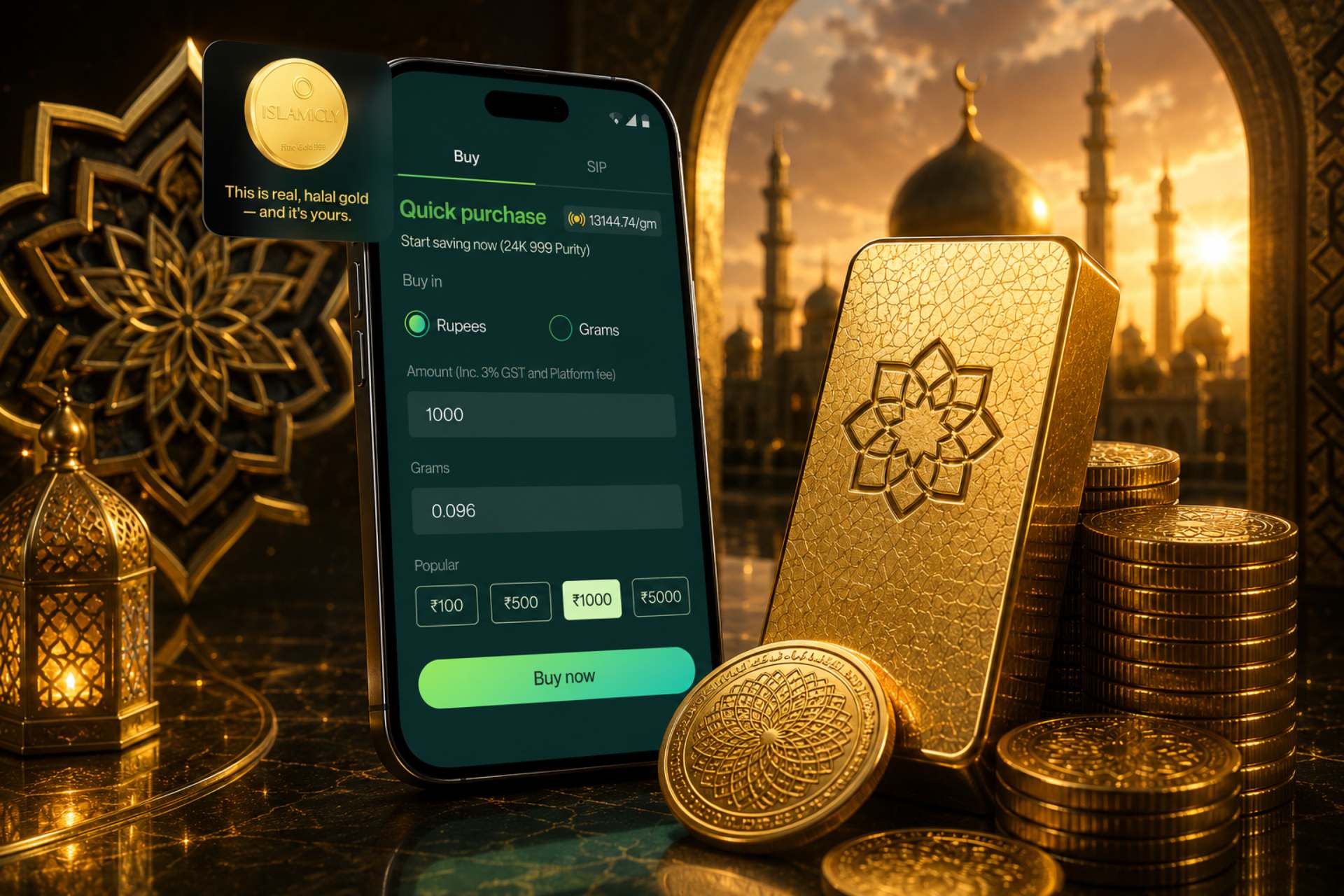
Gold by Islamicly App’s savings goals let you automate gold purchases from as little as ₹100 per day — 24K gold, 100% Halal, stored in your name


No comments yet — be the first to share your thoughts.